
Introduction
Temperature control is essential wherever cooked or processed food must be cooled safely, consistently and at scale. Leaving a large batch to cool naturally can keep it within a temperature range in which bacteria can multiply. It can also affect texture, colour, moisture and the efficiency of the wider production process.
A blast chiller is designed to solve this problem. It removes heat from food much faster than ordinary refrigeration, bringing the product down to a controlled chilled temperature within a defined cycle. This makes blast chilling valuable in restaurants, central kitchens, catering operations and industrial food-manufacturing facilities.
This guide explains what a blast chiller is, what it does, how cold it gets and how industrial blast chilling works. It also covers the difference between blast chilling and blast freezing, along with the factors businesses should consider when specifying a system.
What Does a Blast Chiller Do?
A blast chiller rapidly extracts heat from food so it passes through temperature ranges associated with faster bacterial growth as quickly as the validated process requires. The finished product can then be transferred to suitable refrigerated storage, prepared for distribution or used in a controlled cook-chill operation.
The process can provide several operational and product benefits:
- Improved food safety: Faster cooling limits the time food spends at temperatures favourable to bacterial growth.
- More consistent quality: Rapid cooling can help retain texture, colour, flavour and appearance.
- Reduced moisture loss: Effective chilling may reduce dehydration compared with slow, uncontrolled cooling.
- Longer usable life: When supported by suitable handling, packaging and storage, rapid chilling can help extend product life.
- More efficient production: Businesses can prepare larger batches in advance and organise production around demand.
- Better process control: Programmable cycles and temperature probes help teams monitor and document results.
Blast chilling does not replace good hygiene, correct packaging or refrigerated storage. It forms one controlled stage within a complete food-safety and production process.
How Does a Blast Chiller Work?
Industrial blast chilling combines a refrigeration circuit, high-capacity airflow and intelligent controls. Although system designs differ, the core process normally follows four stages.
1. Hot food enters the chamber
Food is portioned into suitable containers, trays or production trolleys and loaded into the blast chiller. Shallow containers and adequate space between products allow cold air to circulate effectively. Overloading or densely packing the unit can slow the process.
2. Refrigerated air moves at high velocity
Fans drive very cold air over and around the food. This breaks up the insulating layer of warmer air that would otherwise remain around its surface. Heat transfers from the product to the moving air and is then removed through the refrigeration system.
3. The core temperature falls rapidly
The surface cools first, followed by the centre of the food. A core probe may be inserted into the thickest or slowest-cooling item to measure the product rather than relying only on chamber air temperature. Controls can adjust the cycle and stop chilling when the chosen endpoint is reached.
4. The product moves to chilled storage
Once the validated target has been achieved, food should be transferred to suitable cold storage and handled according to the business’s food-safety system. A blast chiller is not normally intended to replace a long-term cold room or storage refrigerator.
How Cold Is a Blast Chiller?
There are two different temperatures to consider: the air temperature inside the machine and the target core temperature of the food.
The chamber air may operate well below 0°C during a chilling cycle because a strong temperature difference helps remove heat rapidly. However, the aim of blast chilling is generally to cool the product to a safe chilled core temperature, not to freeze it. Green Cooling’s systems are designed to reduce cooked or processed food rapidly to around +3°C, with the exact cycle governed by the equipment, product, batch size and operating procedure.
There is therefore no single answer to “what is the temperature of a blast chiller?” A specification should state:
- the starting product temperature;
- the required final core temperature;
- the maximum permitted cycle time;
- the weight and density of the load;
- the chamber’s operating-air range; and
- whether the process is blast chilling or blast freezing.
The correct limits should be set and verified through the site’s HACCP-based food-safety procedures, equipment instructions and applicable regulatory guidance.
Hard Chill and Soft Chill Cycles
Many commercial systems provide more than one blast-chilling programme.
Soft chilling uses a less aggressive air-temperature profile. It is useful for delicate, thin or low-density foods that may be vulnerable to surface freezing or drying.
Hard chilling uses colder air or a more powerful initial phase. It is suited to dense foods, large joints, deep containers and products with a high starting temperature. Controls may raise the chamber temperature later in the cycle to avoid freezing the surface while the core continues to cool.
Selecting the correct cycle matters. The fastest programme is not automatically the best programme if it compromises the product. The food’s composition, size, moisture content, packaging and required finish should all inform cycle development.
Blast Chiller vs Blast Freezer: What Is the Difference?
A blast chiller and blast freezer both remove heat rapidly, but they have different endpoints.
A blast chiller lowers food to a chilled temperature while aiming to keep it above its freezing point. The product is then held in refrigerated storage for later preparation, service or distribution.
A blast freezer takes the product below its freezing point and is designed to reach a frozen core temperature. Fast freezing encourages the formation of smaller ice crystals than slow freezing, which can help protect product structure and reduce moisture loss after thawing.
Some installations support both functions. However, the required refrigeration capacity, airflow, controls, defrost strategy and operating cycle must be correctly specified for the intended loads.
Where Are Industrial Blast Chillers Used?
Blast chillers support any operation that needs repeatable, high-volume temperature reduction. Common applications include:
- food production and manufacturing facilities;
- hotels, restaurants and contract catering kitchens;
- bakeries and confectionery production;
- ice cream and dessert manufacturing;
- central production kitchens;
- supermarkets and food retailers;
- hospitals, schools and other institutional catering sites; and
- event, stadium and transport catering operations.
Green Cooling designs wider cooling solutions for food production and manufacturing, allowing blast chilling to be coordinated with processing, cold storage and distribution requirements.
What Affects Blast-Chilling Time?
Cooling time is not determined by the machine alone. Important factors include:
- Product size and thickness: Heat takes longer to leave the centre of a large or deep item.
- Density and composition: Liquids, sauces, meat and bakery products transfer heat differently.
- Starting temperature: A hotter load presents a larger heat load to the system.
- Batch weight: The total mass must remain within the unit’s rated capacity.
- Tray arrangement: Air must be able to reach all relevant surfaces.
- Packaging: Containers can assist handling but may slow heat transfer.
- Door opening: Unnecessary opening introduces warm, humid air and interrupts the cycle.
- Equipment condition: Dirty coils, blocked airflow or worn components can reduce performance.
A system should be sized using real production data rather than floor area alone. The designer needs to know what will be chilled, how much enters each cycle, the incoming temperature and the time available.
Why Should Data Centres Consider Cooling Redundancy?
For organisations where server availability is business-critical, cooling resilience needs to form part of the wider continuity strategy.
If the only cooling system experiences a fault, temperatures can rise quickly while servers continue producing heat.
Redundant cooling provides additional capacity that can be used if another unit becomes unavailable due to maintenance or unexpected failure.
The appropriate redundancy strategy depends on the size and criticality of the facility.
For some environments, multiple cooling units can share the normal thermal load while maintaining sufficient standby capacity to protect equipment if one unit becomes unavailable.
How Does Environmental Monitoring Protect Server Rooms?
Modern precision cooling systems can work alongside environmental monitoring technology to provide greater visibility over operating conditions.
Sensors can monitor factors such as:
- Room temperature
- Rack inlet temperature
- Humidity
- Cooling equipment performance
- Airflow
- Water or refrigerant leaks
- Power conditions
Alerts can then be generated when conditions move outside predetermined parameters.
Early identification of rising temperatures or equipment problems gives facilities teams an opportunity to respond before the issue results in a significant interruption.
Why Is Cooling System Maintenance Essential?
Data centre cooling systems can operate for long periods without interruption, making planned maintenance particularly important.
Regular inspections can help identify problems with components such as filters, coils, fans, controls, electrical connections and refrigeration systems.
Preventive maintenance can also help:
- Maintain cooling efficiency
- Identify developing faults
- Reduce unexpected breakdowns
- Improve equipment reliability
- Support system longevity
- Maintain consistent cooling performance
Green Cooling provides ongoing monitoring, planned maintenance and system upgrade support alongside cooling system design, installation and commissioning.
What Is a Blast Chiller?
A blast chiller is a specialised refrigeration system that rapidly reduces the temperature of hot or freshly processed food. It uses powerful refrigeration equipment and fast-moving cold air to remove heat quickly and evenly.
Unlike a standard refrigerator, which is principally intended to keep already-chilled products cold, a blast chiller is built to manage a significant heat load. It can therefore cool freshly cooked food far more rapidly without placing the same strain on normal chilled storage.
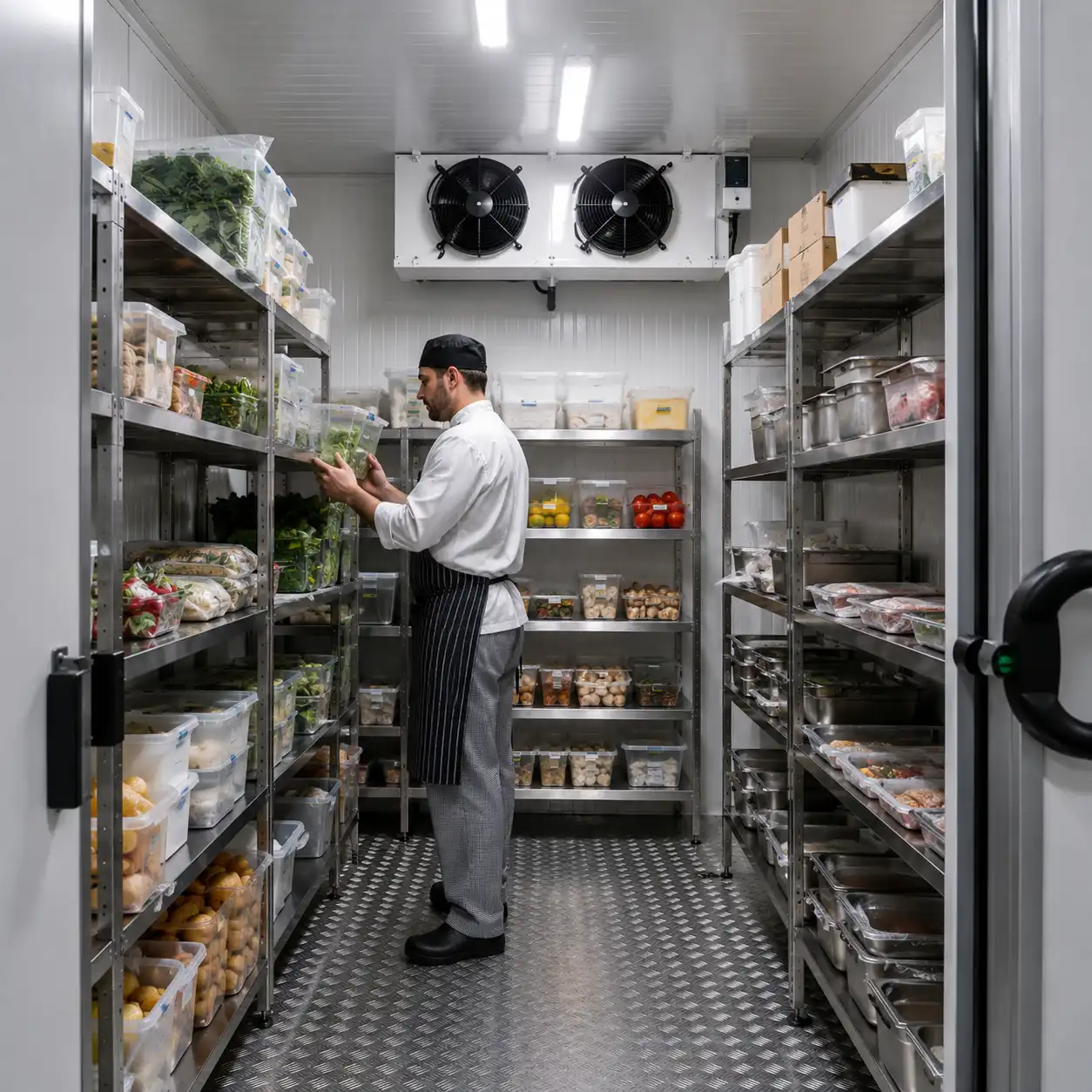
Depending on the application, a blast chiller may be a compact cabinet, a roll-in unit for loaded trolleys, a modular room or a large industrial installation incorporated into a production line. Green Cooling supplies blast chillers and freezers for foodservice and food manufacturing, including tailored high-capacity systems.
How Industrial Systems Improve Energy Efficiency
Blast chilling is energy intensive while a cycle is running, making design and control important. Correctly sized compressors, effective insulation, efficient fans and accurate controls help the system deliver the required cooling without avoidable consumption.
For larger installations, recovered heat may also be used elsewhere in the facility, subject to the building’s demand and system design. Green Cooling can integrate waste-heat recovery into suitable blast-chilling projects, helping businesses lower operating costs and support wider sustainability objectives.
Efficiency also depends on everyday operation. Full but correctly arranged loads, well-maintained door seals, clean heat-exchange surfaces and planned servicing all help maintain performance. An oversized, undersized or poorly maintained unit may use more energy while producing less reliable results.
Choosing an Industrial Blast Chiller
Before selecting a system, define the process rather than starting with a particular model. Consider:
- the product types and their dimensions;
- the maximum kilograms per cycle;
- starting and target core temperatures;
- required cycle time and daily throughput;
- tray, rack or trolley format;
- available space and whether the installation is internal or external;
- drainage, ventilation, electrical and refrigeration requirements;
- monitoring, alarms and temperature-recording needs;
- cleaning access and hygiene requirements; and
- opportunities for lower-impact refrigerants or heat recovery.
Green Cooling offers modular and industrial blast-chilling systems with tailored design, specification and installation. High-capacity solutions are available for demanding operations, including systems designed around loads from 300kg to 1000kg.
Plan Your Blast-Chilling System With Green Cooling
A well-designed blast chiller can make food cooling safer, faster and more repeatable while helping protect product quality. The best results come from matching refrigeration capacity, airflow, controls and chamber layout to the actual production process.
If you are planning a new food-production facility, expanding capacity or replacing older equipment, Green Cooling can develop a solution around your workflow and sustainability goals. Contact Green Cooling to discuss blast chillers, blast freezers, installation and ongoing system support.
Frequently Asked Questions
A blast chiller is specialised refrigeration equipment that removes heat from cooked or processed food rapidly. Powerful fans circulate cold air around the product, reducing its core temperature within a controlled cycle before it is transferred to suitable chilled storage.
A blast chiller moves food quickly through temperature ranges where bacteria can multiply more readily. It supports food safety, production planning and consistent quality by cooling batches predictably while helping retain the product's texture, moisture, colour and overall appearance.
Blast-chiller chamber air can operate below 0°C, but the product is generally cooled rather than frozen. Many processes target a chilled core temperature near +3°C. Exact air settings, endpoints and times depend on the equipment, food and validated procedure.
Cycle time depends on food thickness, density, starting temperature, total load, packaging and airflow. Some commercial processes are designed around approximately 90 minutes, but businesses should use equipment specifications and a verified procedure rather than assume one time suits every product.
No. A blast chiller rapidly lowers food to a chilled temperature without intentionally freezing it. A blast freezer continues cooling until the product reaches a frozen core temperature. Dual-purpose equipment may support both processes through separate, correctly configured operating cycles.
A blast chiller is principally process equipment, not long-term storage. Once food reaches its required core temperature, it should normally be moved to an appropriate refrigerator or cold room. This releases chilling capacity and maintains the correct ongoing storage conditions.
Capacity should reflect the heaviest batch, product dimensions, starting temperature, required endpoint, cycle time and daily throughput. Tray or trolley format, available space and future demand also matter. A refrigeration specialist can calculate loads and design a suitable system.