
Introduction
A cold room needs to maintain the correct storage conditions throughout the working day. However, keeping products cold should not mean accepting unnecessary electricity consumption.
Energy performance depends on how the enclosure, refrigeration equipment and controls work together. A well-insulated room can still waste energy through poorly managed doors, unsuitable equipment or incorrect settings.
Whether you are planning a new installation or reviewing existing storage, understanding the main principles of energy efficient cold room design helps you ask better questions and compare proposals more effectively.
This guide explains the features to look for and how they influence long-term performance.
1. Look Beyond Insulation Thickness
Insulated panels help limit heat entering through the walls, ceiling and floor. However, panel thickness alone does not establish how well the complete enclosure will perform.
Panel joints, door frames and service penetrations also need attention. Gaps or poorly sealed connections can undermine an otherwise suitable specification.
Ask how the proposed construction addresses thermal bridges: areas where heat passes more readily through the enclosure. Good connection details and insulation continuity help limit these pathways.
When comparing proposals, request information about the complete panel system and installation method rather than choosing solely by thickness. Manufacturer guidance highlights the importance of precise joints and thermal bridge management alongside insulation materials.
2. Design Doors Around Real Traffic
Every door opening allows warmer air and moisture to enter the refrigerated space. Frequent or prolonged openings increase the load the refrigeration equipment must manage.
Door design should therefore reflect how products move through the room.
Consider whether staff carry individual items, push loaded trolleys or move pallets. The opening must accommodate normal handling without encouraging the door to remain open unnecessarily.
Useful questions include:
- Is the entrance positioned conveniently for deliveries?
- Can staff locate stock quickly?
- Does the door close reliably?
- Are seals accessible for inspection and replacement?
- Would suitable curtains or another access-control measure help?
A practical layout supports good door management, making efficient operation easier for staff.
3. Match Refrigeration Capacity to the Cooling Load
Choosing the largest available refrigeration unit is not a reliable route to efficiency.
Equipment needs to suit the required temperature and the heat entering the room through products, doors, the enclosure and internal sources. Surrounding temperatures also affect equipment performance.
A system selected using assumptions that do not reflect your operation may struggle during busy periods or operate inefficiently under normal conditions.
Ask your designer to explain the basis of the load calculation and the conditions used for equipment selection.
If future expansion is planned, discuss how it will be accommodated. This might involve a staged approach rather than installing unnecessary capacity immediately.
4. Plan Airflow and Equipment Locations
Refrigerated air must circulate effectively around the stored products. Shelving and stock positions should therefore be considered alongside evaporator placement.
A room that holds enough stock on paper may perform poorly if products block airflow.
Allow the clearances recommended for the equipment and make loading arrangements clear to staff. Avoid treating every empty space as usable storage.
The condenser location matters too. Equipment needs suitable airflow and access for cleaning and servicing. A location that is convenient for installation may create operating difficulties if ventilation is restricted.
Green Cooling’s cold rooms user guide explains why overstocking around cooling equipment can cause problems.
5. Specify Controls That Suit the Application
Controls determine how the refrigeration system responds to changing conditions.
Depending on the application, suitable features may include variable-capacity operation, efficient fan control, temperature alarms and connected monitoring. These should be selected for a clear purpose rather than added as a general technology package.
Ask what each proposed feature does, how it will be configured and who will review the information it provides.
For example, monitoring can help identify unusual operating patterns, but someone needs responsibility for investigating them.
Efficient components deliver their intended benefit when they are correctly selected, commissioned and controlled as part of the complete system.
6. Review Defrost Arrangements
Where frost forms on an evaporator, it can restrict airflow and reduce performance. Defrost is needed to manage this, but its frequency and duration should suit the installation.
Excessive defrost can waste energy, while insufficient defrost can allow ice to accumulate.
Some controllers offer adaptive defrost functions that respond to operating conditions rather than relying only on fixed schedules. Suitability depends on the equipment and application.
Ask your refrigeration specialist how the defrost strategy has been chosen and how it will be checked after commissioning. Settings should be reviewed professionally rather than changed through trial and error. More info please visit – assets.danfoss.
7. Assess Refrigerants and Heat Recovery Separately
Refrigerant selection influences environmental impact, equipment requirements and long-term servicing. However, a refrigerant’s environmental characteristics do not establish the electricity consumption of the complete installation.
Ask how the proposed system will perform under your expected operating conditions.
Heat recovery is another consideration. Suitable refrigeration installations can capture rejected heat for uses such as water heating.
Its value depends on having a useful heating demand when recoverable heat is available. Assess the cooling and heating requirements together rather than assuming every project will benefit equally.
8. Include Commissioning and Maintenance in the Design
Energy performance depends on what happens after equipment is installed.
Commissioning should establish suitable settings, sensor positions, alarm functions and control operation. A poorly positioned sensor or unsuitable control setting can create problems even when the equipment itself is appropriate.
Access for servicing should also be planned from the beginning. Components that are difficult to reach can make routine inspection and cleaning harder.
At handover, ask for operating instructions and a clear explanation of normal behaviour. Staff should know how to recognise and report changes such as temperature instability, unusual ice accumulation or extended running periods.
How to Compare Energy-Efficiency Claims
A general promise of lower running costs is less useful than an estimate with clearly stated assumptions.
When comparing designs, ask suppliers to explain the conditions behind their calculations.
What to compare | Information to request |
Storage duty | Product types, temperatures and loading assumptions |
Room construction | Insulation performance, joints and door details |
Equipment selection | Cooling load and expected surrounding conditions |
Controls | Operating strategy and proposed efficiency features |
Energy estimates | Estimated kWh and the assumptions used |
Running costs | Electricity tariff used to convert kWh into costs |
Aftercare | Commissioning, maintenance and performance review arrangements |
Keep energy consumption and electricity cost separate. A change in tariff can alter the bill without changing how efficiently the room operates.
For an existing installation, compare energy use alongside changes in production, stock levels and weather conditions. A larger bill alone does not identify the cause.
Can an Existing Cold Room Be Improved?
A full replacement is not always the first step.
Begin with an assessment of the enclosure, doors, refrigeration equipment and controls. Identify whether performance issues relate to equipment condition, changed operating demands or settings.
Potential improvements may include repairing seals, addressing airflow restrictions or updating controls. More substantial work may be appropriate where several parts of the installation are ageing or unsuitable.
The best approach depends on the condition of the complete system and the expected benefit of each option.
Start with Your Actual Storage Requirements
Before selecting equipment, establish what the room must do.
A restaurant accessing ingredients throughout service has different requirements from a warehouse holding packaged products with limited daily access. Even rooms with identical dimensions can experience very different cooling loads.
Your design brief should identify:
- The products being stored.
- Required storage temperatures.
- Maximum stock quantities.
- Product temperatures when loaded.
- Delivery frequency and door activity.
- Operating hours and surrounding conditions.
- Expected changes in demand.
This information helps your refrigeration specialist assess the real application rather than selecting equipment from room dimensions alone.
Green Cooling’s commercial and industrial cold rooms can be designed around different storage and operational requirements.
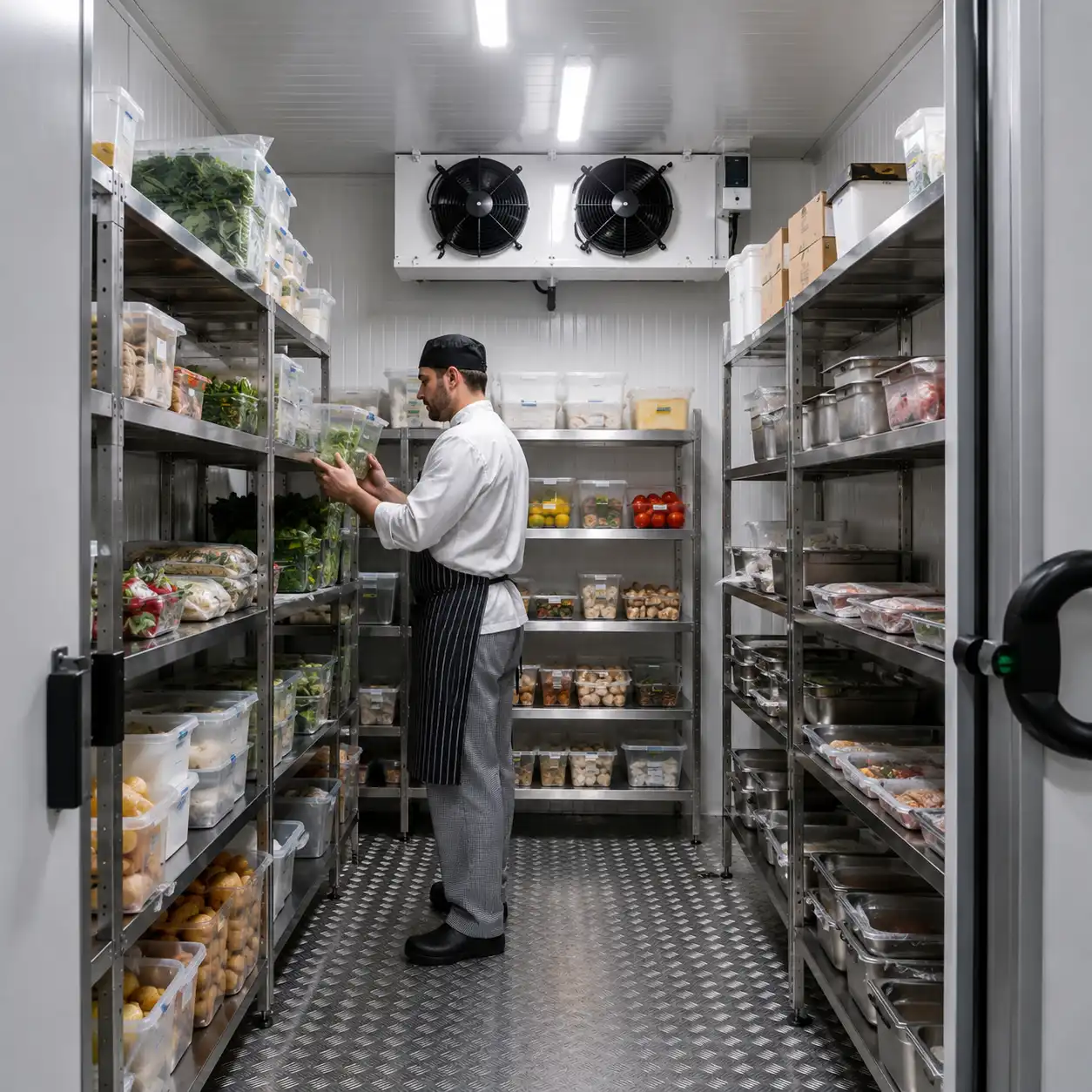
Plan an Efficient Cold Room with Green Cooling
Energy efficient cold room design starts with understanding your operation and selecting a coordinated solution.
Green Cooling provides bespoke cold room design, installation and maintenance support. Whether you need new storage or want to review an existing room, our team can discuss your requirements and the options available.
Contact Green Cooling to discuss your project.
Frequently Asked Questions
Energy efficient cold room design combines suitable insulation, refrigeration equipment, access arrangements and controls to maintain required storage conditions with minimal avoidable energy use. It should reflect actual product loads, operating patterns and site conditions rather than room size alone.
Thicker insulation can reduce heat transfer, but overall performance also depends on the material, panel joints, doors and installation quality. The specification should suit the storage temperature and surrounding conditions. Thickness alone cannot establish the efficiency of the complete room.
Door openings allow warmer air and moisture into the refrigerated space, increasing the cooling load. Suitable door positioning, reliable closing mechanisms and effective seals help manage this. Staff access and delivery routines should also be considered during the design stage.
Suitable controls can reduce unnecessary operation by improving temperature regulation, fan management and defrost arrangements. Results depend on the existing equipment, settings and usage. Controls should be professionally selected and commissioned, with monitoring used to identify opportunities for further improvement.
Yes, improvements may be possible through seal repairs, airflow corrections, maintenance or control upgrades. An assessment should identify the main causes of unnecessary consumption first. The appropriate solution depends on equipment condition, operating requirements and the likely benefit of each change.
No single refrigerant guarantees the lowest electricity consumption in every application. Performance depends on system design, operating temperatures, climate and control strategy. Assess the proposed installation as a whole and consider refrigerant-related environmental impact separately from its predicted energy use.
Request an energy estimate with stated assumptions for storage temperatures, product loading, access and surrounding conditions. Compare proposals using the same operating brief. After installation, review measured consumption alongside actual usage to understand whether performance matches the original design expectations.