
A Practical Guide to Choosing, Planning and Installing Commercial Air Conditioning
Effective temperature control is an important part of creating a comfortable, productive and efficient commercial environment.
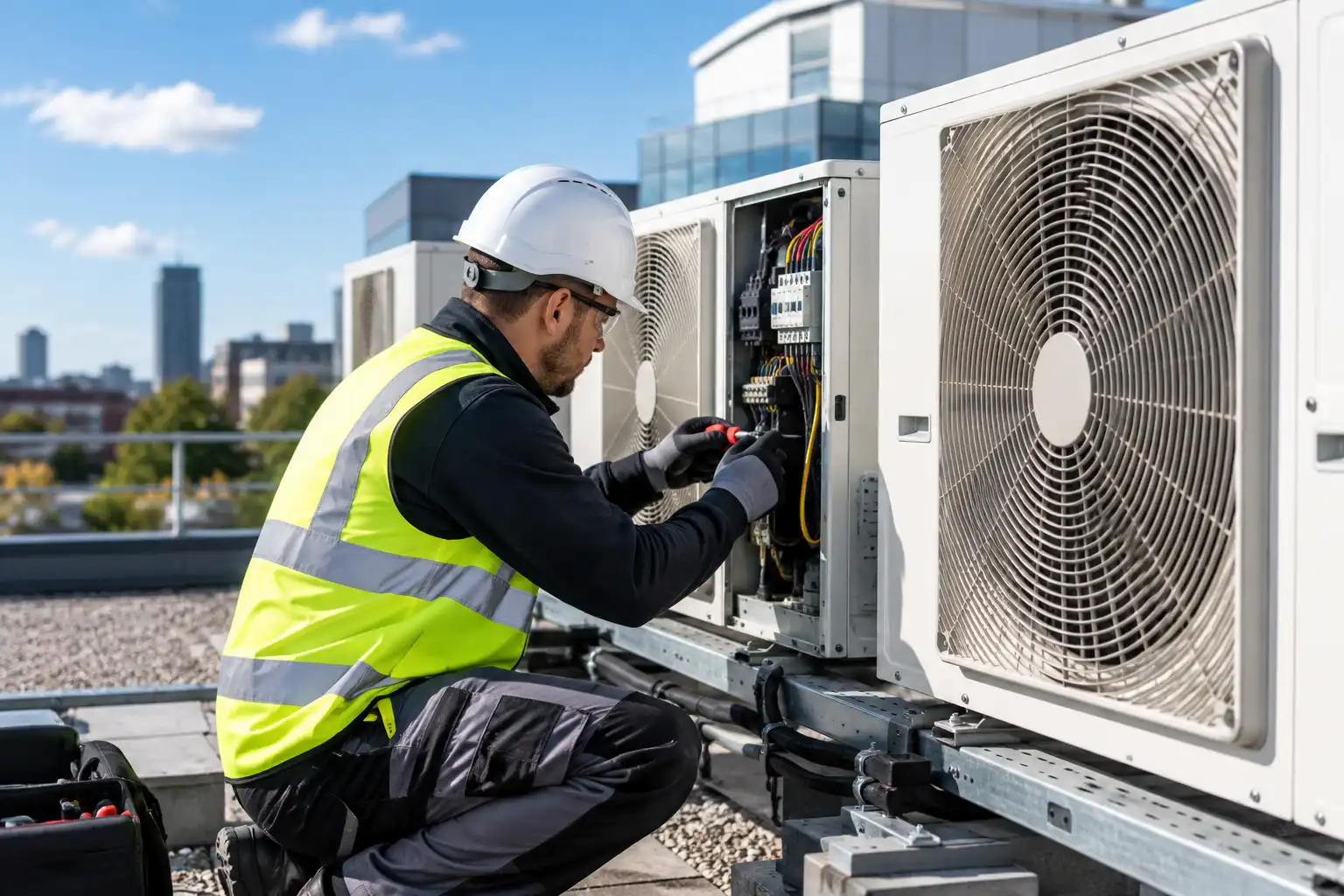
Whether you’re fitting out a new office, upgrading ageing equipment or installing cooling in a commercial building for the first time, commercial air conditioning installation requires considerably more planning than simply choosing an air conditioning unit.
The size and layout of the building, occupancy levels, equipment, operating hours and individual cooling zones all influence which system is appropriate. Installation costs can therefore vary considerably from one project to another.
Working with experienced commercial air conditioning installers helps ensure that equipment is correctly sized, positioned and configured for the way your building is actually used.
In this guide, Green Cooling explains what businesses should expect from the commercial air conditioning installation process, which factors affect cost, how long installation can take and what to consider when comparing different systems.
How Does Commercial Air Conditioning Work?
Most modern commercial air conditioning systems operate by transferring heat rather than simply producing cold air.
During cooling, heat is absorbed from inside the building and transferred elsewhere through the refrigeration cycle.
Many contemporary systems can also reverse this process using heat pump technology, allowing them to provide heating as well as cooling.
Depending on the system, a commercial installation may consist of one or more indoor units connected to outdoor equipment.
Larger systems can serve multiple areas or temperature zones, allowing businesses to control different sections of the property independently.
For example, an office may require different temperature settings for an open-plan workspace, meeting rooms, reception and server room.
This flexibility can improve comfort while avoiding the need to cool every area of the building identically.
What Happens During a Commercial Air Conditioning Installation?
Professional commercial air conditioning installation usually involves several stages.
The precise process depends on the building and complexity of the project, but businesses can generally expect the following.
1. Initial Consultation
The first stage is understanding what the business needs the system to achieve.
This may include discussing:
- Current temperature-control problems
- Number of rooms requiring cooling
- How different areas are used
- Existing air conditioning or heating equipment
- Operating hours
- Future plans for the building
- Energy-efficiency objectives
- Budget considerations
This initial conversation helps establish the scope of the project.
2. Site Survey and Assessment
A site assessment allows the installer to examine the building and determine the practical requirements of the installation.
This is a crucial step because floor area alone does not determine how much cooling a building requires.
A commercial air conditioning survey may consider:
- Room dimensions
- Ceiling heights
- Number of occupants
- Windows and solar gain
- Building orientation
- Insulation
- Lighting
- Computers and electrical equipment
- Machinery
- Ventilation
- Existing heating systems
- Operating hours
- Installation access
- Potential locations for indoor and outdoor equipment
These factors help determine the cooling load and suitable system capacity.
Why Is Correct Air Conditioning Sizing Important?
One of the biggest mistakes in commercial air conditioning is assuming that more cooling capacity is automatically better.
It isn’t.
An undersized system may struggle to maintain the desired temperature and could operate for extended periods trying to meet demand.
An unnecessarily oversized system can also create problems, including additional capital cost and inefficient operation.
Correct sizing therefore involves calculating the likely cooling demand of the building rather than simply selecting equipment based on room size.
This is one of the reasons professional system design matters.
The aim should be to install sufficient capacity to manage the required conditions efficiently without unnecessarily overspecifying the equipment.
Choosing the Right Commercial Air Conditioning System
There are several types of commercial air conditioning system, and no single solution is appropriate for every building.
Split Air Conditioning Systems
A split system typically connects an indoor air conditioning unit to an outdoor unit.
These systems can be suitable for smaller commercial environments or individual rooms requiring independent temperature control.
Applications can include:
- Small offices
- Meeting rooms
- Shops
- Treatment rooms
- Individual hospitality spaces
They can provide an effective solution where only a limited number of areas require air conditioning.
Multi-Split Air Conditioning
Multi-split systems allow multiple indoor units to connect to outdoor equipment.
This can be useful when several rooms require individual temperature control but installing separate outdoor units for every room would be impractical.
Individual indoor units can generally be controlled separately, providing flexibility across the building.
Larger Multi-Zone Systems
Larger commercial buildings often require more sophisticated systems capable of serving numerous areas with different temperature requirements.
These systems can provide individual zone control while supporting larger and more complex properties.
They can be suitable for environments such as:
- Multi-storey offices
- Hotels
- Larger retail premises
- Education facilities
- Mixed-use commercial buildings
The appropriate configuration should be determined by the requirements of the property rather than selecting a system type before the building has been assessed.
What Is Commercial Air Conditioning?
Commercial air conditioning refers to systems designed to control the temperature and indoor environment of premises used for business or commercial purposes.
These can range from relatively straightforward systems serving a small office or retail unit to larger installations controlling temperatures across multiple floors, departments or buildings.
Commercial air conditioning can be used within environments including:
- Offices
- Shops and showrooms
- Restaurants and cafés
- Hotels
- Leisure facilities
- Schools and educational buildings
- Warehouses
- Manufacturing facilities
- Industrial premises
- Server and IT rooms
- Healthcare and specialist environments
The appropriate system depends on the requirements of the building.
A small office containing several employees and computers will have very different cooling demands from a hotel, restaurant, warehouse or manufacturing facility.
That makes correct system design one of the most important parts of any commercial installation.
How Much Does Commercial Air Conditioning Installation Cost?
There is no universal price for commercial air conditioning installation because the scale and complexity of projects varies significantly.
A single-room office installation is fundamentally different from providing temperature control across a large commercial or industrial facility.
Several factors determine the eventual cost.
Size of the Property
Larger buildings typically require greater cooling capacity and potentially more indoor units, pipework and controls.
However, floor area is only one factor.
A smaller room containing significant electrical equipment could have a greater cooling requirement than a much larger space with relatively low occupancy.
Number of Air Conditioning Units
The number and type of indoor and outdoor units required will directly influence equipment and installation costs.
A single split system will generally involve a simpler installation than a large multi-zone solution.
Type of System
Different air conditioning technologies have different equipment, design and installation requirements.
The most appropriate solution should therefore be selected based on whole-life suitability rather than initial equipment price alone.
Complexity of Installation
Every building presents different practical challenges.
Long pipe runs, restricted access, difficult outdoor-unit positioning and work across multiple floors can increase installation complexity.
Controls
More sophisticated control systems can provide businesses with greater flexibility over temperatures, scheduling and energy use.
These features may increase initial costs but can provide valuable operational benefits.
Existing Equipment
Replacing an existing system may involve removing old equipment or adapting parts of the installation.
Alternatively, some existing infrastructure may potentially be retained where appropriate.
Building Use
Cooling requirements can change significantly depending on what happens inside the property.
Restaurants, server rooms, manufacturing facilities and densely occupied offices can all produce substantial internal heat loads.
For this reason, businesses should be cautious of generic online commercial air conditioning price estimates.
A site-specific quotation provides a much more meaningful indication of the likely investment.
What Should Be Included in a Commercial Air Conditioning Quote?
When comparing quotations from commercial air conditioning installers, price should not be the only consideration.
Businesses should understand what the proposed installation actually includes.
Depending on the project, a quotation may cover:
- System design
- Air conditioning equipment
- Indoor and outdoor units
- Controls
- Pipework and associated materials
- Installation labour
- Electrical requirements where specified
- Testing
- Commissioning
- Removal of existing equipment where applicable
- Documentation
- Maintenance options
If two quotations differ substantially, it is worth establishing whether they are genuinely proposing equivalent systems and scopes of work.
A cheaper quotation is not necessarily better value if equipment capacity, controls, installation quality or aftercare differ.
How Long Does Commercial Air Conditioning Installation Take?
Installation time depends primarily on the scale and complexity of the project.
A relatively straightforward installation serving a small number of rooms may be completed considerably faster than a multi-zone installation throughout a large commercial building.
Factors affecting timescales include:
- Number of units
- Building size
- Access
- Pipework routes
- Electrical requirements
- Working-height requirements
- Existing systems
- Whether the premises remain operational during installation
- Commissioning requirements
For occupied commercial buildings, installers may also need to schedule work carefully to minimise disruption.
This should be discussed during the planning stage so the installation programme can be coordinated around normal business activities where practical.
Can Commercial Air Conditioning Be Installed Without Closing the Business?
In many cases, yes.
Commercial installations are frequently carried out within occupied buildings, although the feasibility depends on the scope of work.
Installers may be able to phase work across individual rooms, departments or floors rather than disrupting the entire property simultaneously.
For businesses with particularly sensitive operating requirements, planning becomes even more important.
Potential considerations include:
- Working outside normal operating hours
- Completing installation in phases
- Maintaining access routes
- Managing noise
- Coordinating temporary room closures
- Scheduling work around customers or employees
Discussing these requirements early allows the installation programme to take them into account.
Energy Efficiency and Commercial Air Conditioning
Energy consumption should be considered when choosing commercial air conditioning because the system may operate for many hours throughout the year.
Modern equipment can incorporate technologies designed to reduce unnecessary consumption and improve control.
These can include:
- Inverter-driven compressors
- Heat pump technology
- Individual zoning
- Programmable schedules
- Intelligent controls
- Occupancy-based operation
- More efficient equipment
- Improved system monitoring
However, even highly efficient equipment can perform poorly when incorrectly designed or operated.
Correct system sizing, sensible temperature settings, zoning and regular maintenance all contribute to overall energy performance.
Businesses should therefore consider the complete installation rather than comparing equipment efficiency figures in isolation.
Can Commercial Air Conditioning Provide Heating?
Many modern commercial air conditioning systems can provide both cooling and heating through heat pump technology.
During warmer conditions, heat is removed from the indoor environment. During colder conditions, the process can be reversed so heat is transferred into the building.
This can make air conditioning a useful year-round temperature-control solution in suitable commercial environments.
Whether it should replace or complement an existing heating system depends on factors such as the building, operating requirements and equipment selected.
Heating requirements should therefore form part of the initial system-design discussion rather than being considered after installation.
What About Ventilation?
Air conditioning and ventilation are related but are not necessarily the same thing.
Air conditioning primarily manages indoor temperature and, depending on the system, other aspects of the internal environment. Ventilation concerns the supply and removal of air.
Businesses should not automatically assume that installing air conditioning resolves all ventilation requirements.
Where ventilation is important to a project, it should be considered as part of the wider building-services strategy.
This is particularly relevant for densely occupied environments and buildings where indoor air quality is a major consideration.
Replacing an Existing Commercial Air Conditioning System
Commercial air conditioning equipment does not last indefinitely.
As systems age, businesses may experience declining performance or increasing maintenance requirements.
Common indications that existing equipment may need assessment include:
- Rising energy consumption
- Increasingly frequent breakdowns
- Difficulty maintaining consistent temperatures
- Excessive noise
- Poor controls
- Obsolete equipment
- Difficulty obtaining components
- Changing requirements within the building
Replacement does not necessarily mean recreating the previous installation exactly.
If the building’s occupancy, layout or use has changed, the cooling requirements may also have changed.
A replacement project therefore provides an opportunity to reassess the property and determine whether a different system or configuration would now be more appropriate.
The Importance of Commercial Air Conditioning Maintenance
Even a well-designed air conditioning system requires ongoing attention.
Regular maintenance can help preserve system performance, identify developing faults and reduce the likelihood of unexpected failures.
Commercial air conditioning maintenance can include checks of:
- Filters
- Coils
- Controls
- Electrical components
- Refrigeration-system performance
- Drainage
- General equipment condition
The exact requirements depend on the equipment and environment.
A system operating continuously in demanding conditions may need a different maintenance programme from equipment used only occasionally.
Businesses should also follow manufacturer requirements and any applicable regulatory obligations.
Choosing Commercial Air Conditioning Installers
The quality of the installer is just as important as the equipment selected.
Businesses should look beyond the cost of the air conditioning units themselves and consider whether the contractor understands commercial system design.
Useful questions include:
- Do they specialise in commercial cooling?
- Will they assess the building before specifying equipment?
- How is the required cooling capacity calculated?
- Can they explain why a particular system has been recommended?
- Will they manage installation and commissioning?
- What ongoing maintenance is available?
- Do they have experience with comparable commercial environments?
- Can they support more complex cooling requirements if required?
An experienced installer should be able to explain the reasoning behind the proposed system rather than simply providing a list of equipment.
Commercial Air Conditioning Installation from Green Cooling
Green Cooling specialises in commercial cooling and temperature-control solutions.
Our experience covers commercial air conditioning alongside areas such as commercial refrigeration, cold rooms and specialist cooling systems, giving our team an understanding of temperature control across a wide range of business environments.
We can support commercial air conditioning projects from the initial assessment through to system design, installation and ongoing maintenance.
Our approach focuses on understanding how the building is used and recommending a solution appropriate for its cooling requirements.
Whether you need air conditioning for an office, retail premises, hospitality venue, industrial building or another commercial environment, our team can help you determine the appropriate way forward.
Planning a Commercial Air Conditioning Installation?
The most effective commercial air conditioning systems begin with the building rather than the equipment.
Correctly assessing cooling requirements, selecting suitable technology and designing the installation around how the premises are used can improve comfort, control, reliability and energy efficiency.
Green Cooling can support businesses through the complete process, from initial advice and system design to commercial air conditioning installation and ongoing maintenance.
Contact Green Cooling to discuss your commercial air conditioning requirements and arrange expert advice for your premises.
Frequently Asked Questions About Commercial Air Conditioning Installation
There is no fixed commercial air conditioning installation price because costs depend on the building and system required. Property size, cooling load, number of units, equipment type, controls, access and installation complexity can all influence the quotation. A small office requiring a limited number of units will naturally have different requirements from a multi-storey commercial building. A professional site assessment is therefore the best way to establish a meaningful project cost and ensure the quotation is based on correctly sized equipment.
Air conditioning should ideally be sized using a cooling-load assessment rather than floor area alone. Room dimensions matter, but so do occupancy, windows, solar gain, lighting, computers, machinery, insulation and operating hours. These factors determine how much heat the system needs to remove. Correct sizing is important because both undersized and oversized equipment can create performance and efficiency problems. A commercial installer can assess these variables and recommend appropriate system capacity.
The best solution depends on the building. A smaller office or retail unit might require a relatively straightforward split or multi-split system, while a larger building could benefit from a more sophisticated multi-zone installation. Buildings with specialist environments such as server rooms may require dedicated cooling separate from the main comfort system. The right approach is therefore to identify the building's requirements first and select equipment accordingly.
Timescales vary according to project size and complexity. A straightforward installation serving a small commercial space may take considerably less time than a system covering multiple floors or numerous temperature zones. Access, pipework, electrical work and whether the building remains occupied can all influence the programme. A commercial installer should be able to provide an expected schedule once the property and proposed system have been assessed.
Yes. Commercial air conditioning is regularly retrofitted into existing offices, shops, hospitality venues and other business premises. The installation needs to consider the existing building layout, suitable equipment locations and practical routes for pipework and services. Older buildings or properties with limited external space can present additional challenges, but a site survey can identify appropriate options.
Many installations can be completed without a conventional planning application, but requirements depend on the property, location and proposed equipment. Restrictions can apply to listed buildings, conservation areas or installations where external equipment affects the appearance or surroundings of a property. Businesses should establish any relevant permissions before work begins rather than assuming every installation is treated identically.
Running costs depend on system efficiency, operating hours, temperature settings, building performance and how the equipment is controlled. Modern systems can offer efficient operation, particularly when correctly sized and divided into appropriate zones. Poor system design or unnecessarily cooling unused areas can increase energy consumption. Regular maintenance and sensible controls can also help businesses manage ongoing energy use.
Maintenance frequency depends on the equipment and how intensively it operates. Commercial systems used extensively may require more frequent attention than equipment operating occasionally. Regular servicing can help maintain performance and identify developing issues. Businesses should consider manufacturer guidance, system usage and applicable regulatory requirements when establishing their maintenance schedule.
Many modern systems use reversible heat-pump technology and can provide both heating and cooling. This can allow businesses to use one system for year-round temperature management. Whether this is appropriate for a particular building depends on its requirements and the equipment selected, so heating demand should be considered during system design.
The answer depends on the condition, age and performance of the equipment. Repair may be sensible where the system remains efficient and parts are readily available. Replacement may become more attractive where breakdowns are frequent, energy use is high, equipment is obsolete or the requirements of the building have changed. An assessment of the existing installation can help determine the most practical long-term option.