
CO2 Refrigeration on the Rise: Why Businesses Are Switching Back
CO2 refrigeration is experiencing a major resurgence as a mainstream cooling technology, attracting attention across commercial and industrial sectors worldwide. After being overshadowed by ammonia and synthetic refrigerants for decades, modern CO2 systems are now recognised for their efficiency, safety, and environmental advantages.
From supermarkets and food production facilities to cold storage warehouses, businesses are increasingly adopting CO2 refrigeration to reduce energy consumption, lower operating costs, and meet sustainability goals. One of the main drivers of this comeback is the growing demand for eco-friendly refrigerants with low global warming potential. CO2, a natural refrigerant, has a GWP of only 1 and zero ozone depletion potential, making it far more environmentally responsible than traditional alternatives.
Combined with smaller, more compact compressors and advanced system designs, CO2 refrigeration offers a cost-effective, reliable, and high-performance solution for organisations seeking to modernise their cooling infrastructure while aligning with environmental regulations.
Why Use CO2 Refrigeration?
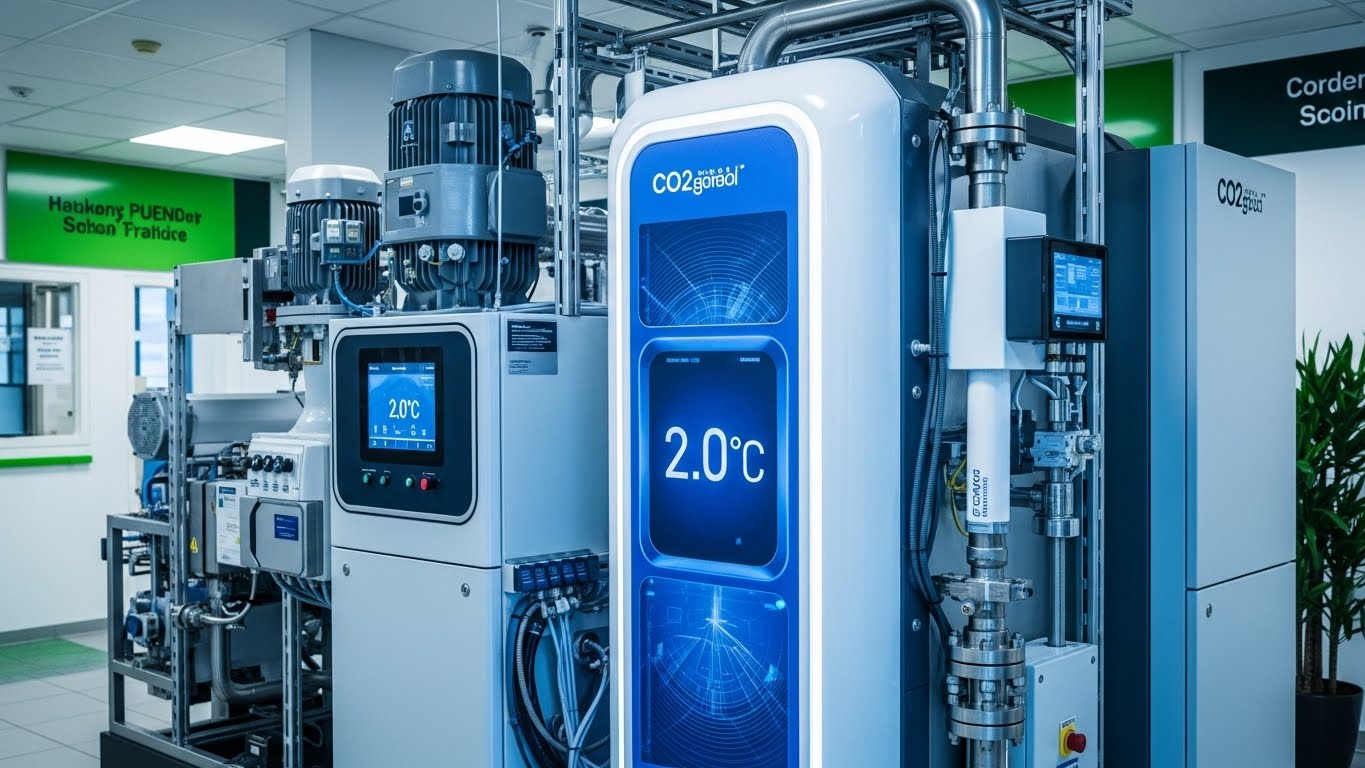
CO2, or carbon dioxide, offers several advantages over traditional refrigerants, making it a preferred choice for many companies:
- Compact Compressors: As a very dense gas, CO2 allows compressors to be smaller and more space-efficient compared to ammonia-based systems. This saves valuable floor space in commercial facilities.
- Environmentally Friendly: CO2 is a natural refrigerant with an ozone depletion potential (ODP) of zero and a global warming potential (GWP) of only 1, making it far more sustainable than many synthetic alternatives.
- Safe and Low-Risk: It has low toxicity and is non-flammable, providing safety benefits for operators and customers alike.
- Efficient at Low Temperatures: CO2 refrigeration outperforms ammonia systems in efficiency at lower temperatures, particularly for applications such as frozen storage.
- Lower Operating Costs: Over the lifespan of the system, maintenance and operating expenses are proven to be lower, delivering both performance and cost savings.
These factors explain why CO2 refrigeration technology is rapidly regaining popularity in commercial and industrial sectors.
How Much Does a CO2 System Cost?
Historically, CO2 refrigeration systems were more expensive to install than traditional ammonia-based systems, which limited their adoption for many businesses. However, advances in technology and increased competition have narrowed this gap, making installation costs for CO2 systems comparable to other refrigerants. This shift has made CO2 a viable option not just for large enterprises, but also for small and medium-sized businesses looking to modernise their refrigeration.
Investing in a CO2 system offers long-term benefits that extend beyond initial costs. Businesses can enjoy higher energy efficiency, lower operating and maintenance expenses, and a smaller environmental footprint, all of which contribute to sustainable operations and potential savings over the system’s lifetime.
The resurgence of CO2 refrigeration began in the 1990s when Gustav Lorentzen re-invented the technology, and since then, it has steadily gained recognition worldwide as a reliable, eco-friendly, and efficient solution for diverse industries, from retail and hospitality to cold storage and industrial applications.
Green Cooling CO2 Solutions
At Green Cooling, we provide full CO2 system surveys, installations, and maintenance services throughout the UK. Our team works with businesses in retail, food production, hospitality, and more to design bespoke CO2 refrigeration solutions tailored to their needs.
By choosing Green Cooling, companies gain access to expert guidance, energy-efficient systems, and long-term support to ensure their refrigeration is reliable, safe, and environmentally responsible.
If you want to learn more, please contact us today on 01253 685 145 or view our related CO2 refrigeration page.
Final Words
CO2 refrigeration is firmly back in the spotlight, offering a powerful combination of energy efficiency, operational safety, and environmental sustainability at competitive costs. Businesses that invest in CO2 systems can expect reliable long-term performance, lower maintenance and running expenses, and a significantly reduced carbon footprint, all of which contribute to a more sustainable and profitable operation.
By choosing Green Cooling, companies gain access to bespoke CO2 refrigeration solutions tailored to their unique requirements. Our team ensures that every installation is optimised for maximum efficiency, regulatory compliance, and long-term reliability, helping your business stay ahead in both sustainability initiatives and operational efficiency.
Partnering with experts like Green Cooling guarantees peace of mind and a refrigeration system designed to support your business goals for years to come.
Frequently Asked Questions
What industries benefit most from CO2 refrigeration?
CO2 refrigeration is particularly suited to supermarkets, cold storage warehouses, food processing plants, and the hospitality sector. It is ideal wherever frozen and chilled storage efficiency is critical, especially for large-scale operations with frequent door openings or high-volume storage.
Can CO2 systems be retrofitted into existing refrigeration setups?
Yes. Many existing facilities can upgrade to CO2 refrigeration without completely replacing their current infrastructure. However, a professional survey and system assessment are essential to ensure compatibility, proper sizing, and efficiency.
How does CO2 compare to ammonia in terms of environmental impact?
CO2 is a natural refrigerant with zero ozone depletion potential and a global warming potential (GWP) of just 1, making it far more environmentally friendly than many traditional alternatives. Ammonia, while having a negligible GWP, requires careful handling due to its toxicity and flammability, which adds safety challenges.
Are CO2 refrigeration systems more expensive to maintain?
No. In fact, CO2 systems often have lower maintenance costs compared to traditional refrigeration setups. Their smaller, more efficient compressors require less frequent servicing, and the non-toxic, non-flammable refrigerant reduces the need for specialised safety equipment. Over time, these advantages translate into significant cost savings, making CO2 systems both operationally and financially efficient.
How efficient are CO2 systems at very low temperatures?
CO2 refrigeration excels at maintaining stable, ultra-low temperatures, often outperforming ammonia or synthetic refrigerants in frozen storage applications. This makes it ideal for ultra-cold and frozen food storage, ice cream production, and temperature-sensitive products.