
Introduction
Reliable temperature control is fundamental to modern food production. Whether a facility manufactures meat products, dairy foods, sauces, bakery goods, confectionery or frozen desserts, cooling influences food safety, consistency, shelf life, production capacity and energy costs.
However, industrial food refrigeration is not a single item of equipment. A production site may need process chillers to control ingredients, blast chillers to reduce product temperatures rapidly, cold rooms for controlled storage and specialist refrigeration systems to serve several temperature zones. The correct combination depends on the product, process, throughput and wider site infrastructure.
This guide explains the principal cooling systems used in food manufacturing, how they support different stages of production and what businesses should consider when planning a new installation or upgrading an existing system.
Why Is Cooling So Important in Food Manufacturing?
Temperature can affect food throughout its journey from raw material to finished product. If it is not controlled effectively, a manufacturer may experience inconsistent output, shorter shelf life, excessive waste, avoidable downtime or food-safety risks.
Supporting food safety
Many food products require controlled temperatures to limit microbial growth. Refrigeration must work alongside hygiene procedures, time controls, monitoring and the site’s HACCP-based food-safety system.
Protecting product quality
Accurate cooling can help protect texture, flavour, colour, structure and moisture. Chocolate, cheese, sauces, meat, ice cream and baked products all react differently to temperature, so generic settings rarely deliver the best result.
Increasing production consistency
Repeatable temperatures help manufacturers reproduce the same process conditions from one batch to the next. This supports consistent quality and reduces the need for reworking or rejecting products.
Extending usable product life
Rapid and controlled cooling, followed by appropriate storage, can help preserve product quality for longer. The actual usable life must be established through the manufacturer’s validated process, packaging and food-safety controls.
Maintaining production capacity
If cooling cannot keep pace with production, it becomes a bottleneck. Correctly sized systems allow equipment, ingredients and finished goods to move through the facility at the required rate.
Main Types of Industrial Food Refrigeration
Different stages of production require different cooling methods. The following systems are often combined within an integrated refrigeration strategy.
1. Food Processing Chillers
Food processing chillers remove heat from process water, glycol or another secondary fluid. The chilled fluid can then serve equipment, jacketed vessels, mixing processes, cold tables or product heat exchangers.
They are used where a production process requires accurate, repeatable cooling rather than general refrigerated storage. Typical applications include:
- controlling milk and dairy processes;
- cooling sauces and liquid foods;
- maintaining temperature during meat processing;
- supporting chocolate and confectionery production;
- controlling bakery processes; and
- serving ice cream and frozen-dessert equipment.
Processing chillers may be air-cooled or water-cooled. Air-cooled systems reject heat to ambient air and can offer a practical, self-contained arrangement. Water-cooled systems reject heat through a water circuit and may suit sites where plant layout, sound levels or operating conditions favour this approach.
The correct selection depends on required fluid temperatures, heat load, ambient conditions, water availability, operating hours and opportunities for redundancy or heat recovery.
2. Blast Chillers and Blast Freezers
Blast chilling rapidly reduces the temperature of cooked or processed food. High-velocity refrigerated air removes heat much more quickly than ordinary storage refrigeration, helping products pass through critical temperature ranges within a controlled time.
A blast freezer performs a related function but continues cooling until the product reaches a frozen core temperature. Fast freezing can encourage smaller ice crystals than slow freezing, which may help protect product structure and reduce moisture loss after thawing.
Green Cooling supplies blast chillers and freezers for commercial kitchens and industrial production, including modular and high-capacity systems.
Important specification factors include:
- starting and target core temperatures;
- kilograms of product per cycle;
- product density and dimensions;
- tray or trolley format;
- maximum cycle duration; and
- the number of cycles required each day.
A unit should be selected around real products and loads. Nominal chamber size alone does not show whether the system can achieve the required pull-down time.
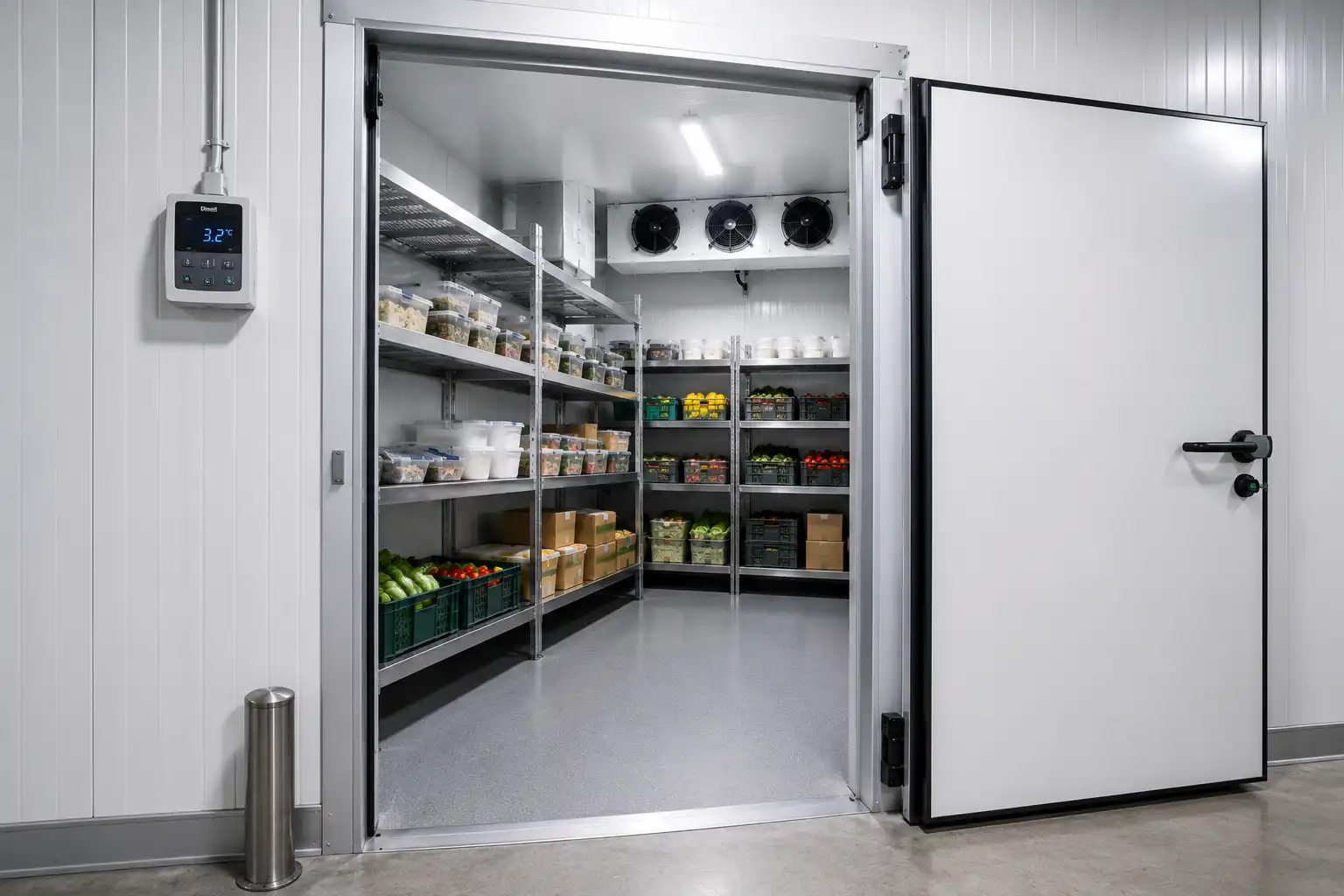
3. Commercial Cold Rooms and Freezer Rooms
Cold rooms maintain products at a controlled chilled temperature after processing or blast chilling. Freezer rooms provide long-term storage below freezing.
Unlike blast chillers, cold rooms are usually intended to hold products already near their target storage temperature. Loading large quantities of hot food into a storage room can raise the room temperature, strain the plant and affect other stock.
Commercial cold rooms can be designed for ingredients, work in progress, finished products or dispatch stock. A specification may include:
- insulated wall, ceiling and floor panels;
- food-safe internal finishes;
- shelving or racking layouts;
- personnel and pallet access;
- evaporators positioned for effective airflow;
- temperature recording and alarm systems;
- door protection and emergency release mechanisms; and
- capacity for future expansion.
The design should reflect how frequently doors open, how much warm product enters, room occupancy, external ambient conditions and the consequences of equipment failure.
4. CO₂ Refrigeration Systems
CO₂, also known as R744, is a natural refrigerant used in chilled, frozen and process-cooling applications. It has a global warming potential of 1 and zero ozone-depletion potential, making it an important option for organisations seeking to reduce the refrigerant-related environmental impact of their operations.
Modern CO₂ refrigeration systems can serve several temperature levels from one integrated installation. Depending on the design, a system may support process cooling, cold rooms, freezer rooms and heat recovery.
CO₂ systems operate at higher pressures than many traditional refrigeration technologies and require specialist design, installation and maintenance. When correctly applied, they can provide reliable performance, support long-term refrigerant strategies and produce useful high-grade heat for recovery.
5. Hydrocarbon and A2L Refrigeration
Hydrocarbon refrigerants and lower-GWP A2L refrigerants provide additional options for manufacturers moving away from higher-impact refrigerants. Each has its own characteristics, charge limits, safety requirements and suitable applications.
The decision should not be based on global warming potential alone. Equipment location, system capacity, ventilation, fire-risk controls, maintenance competence, future availability and total lifetime cost must all be considered during design.
6. Heat Recovery and Hot Water Generation
Refrigeration systems remove heat from products and spaces, then reject that heat elsewhere. A heat recovery system captures some of this otherwise wasted energy and makes it available for a useful purpose.
In food manufacturing, recovered heat may contribute to:
- washdown water;
- domestic hot water;
- space heating;
- pre-heating process water; or
- other suitable production duties.
Heat recovery can reduce reliance on separate boilers or electric water heating. Its value depends on matching available waste heat with a simultaneous and suitable heating demand. Storage vessels, controls and backup heating may be needed to manage differences between supply and demand.
How Do These Systems Work Together?
The strongest food manufacturing cooling systems are designed as one coordinated strategy rather than several unrelated machines.
For example, a cooked-food manufacturer could use:
- a process chiller to serve ingredient preparation and production equipment;
- a blast chiller to reduce freshly cooked products to a defined core temperature;
- a cold room to hold packaged products before dispatch;
- an integrated refrigeration plant to serve several temperature zones; and
- heat recovery to generate part of the site’s hot-water requirement.
Integration can reduce duplicated plants, improve control and create opportunities to recover energy. However, it must not create a single point of failure that could stop the entire production process. Critical loads may require standby capacity, separate circuits or an emergency-response plan.
Cooling Requirements for Different Food Products
Every food manufacturing process creates a different load profile.
Meat and poultry
Meat production may require chilled preparation rooms, process cooling, rapid chilling, cold storage and washdown hot water. Equipment must tolerate frequent cleaning and maintain stable conditions despite changing occupancy and product loads.
Dairy and cheese
Dairy production often requires precise cooling of milk, cultures, yogurt or cheese-making processes. Stable fluid temperatures and hygienic heat exchange are important for repeatable product quality.
Bakery and confectionery
Bakeries may need cooling for dough handling, chocolate production, cream storage and finished products. Humidity and condensation can be as important as temperature because they affect appearance and texture.
Sauces and prepared foods
Liquids and dense foods can retain heat at their centre. Vessel design, agitation, heat-exchanger selection and batch depth all influence cooling time.
Ice cream and frozen desserts
These operations require controlled freezing, low-temperature storage and reliable performance during peak loads. Temperature variation can affect texture and product stability.
Designing an Industrial Food Refrigeration System
A reliable design begins with a detailed understanding of production. The refrigeration contractor should evaluate more than the desired room temperature.
Calculate the full heat load
Calculations should include product load, transmission through the building fabric, people, lighting, fans, machinery, door openings, defrost cycles and external conditions. Future growth should also be considered, but unnecessary oversizing can reduce efficiency and increase capital cost.
Understand the production schedule
Two facilities with the same daily output may need different systems if one runs continuously and the other processes large batches. Peak load and the time available to remove it matter as much as total daily production.
Design around workflow
Cooling equipment should support the direction in which ingredients and products move through the facility. Poor layouts can cause congestion, excessive door opening and unnecessary movement between controlled areas.
Allow for cleaning and hygiene
Food-production environments require accessible, cleanable equipment and effective drainage. The location of evaporators, pipework, controls and sensors should support cleaning without creating avoidable contamination risks.
Plan resilience
Failure can cause lost production or spoiled stock. Critical sites should consider standby compressors, duty-and-assist arrangements, separate circuits, remote alarms and access to responsive technical support.
Food Safety, Monitoring and Compliance
Refrigeration supports food safety, but the equipment alone cannot guarantee it. Manufacturers need defined limits and corrective actions within their food-safety management system.
Useful monitoring measures can include:
- calibrated room and product-temperature sensors;
- core probes for cooling processes;
- automatic data logging;
- high- and low-temperature alarms;
- door-open alarms;
- remote system monitoring; and
- records of servicing and calibration.
Temperature settings should reflect the product, process, legal requirements, customer standards and validated shelf-life procedures. Staff must also understand what to do if a limit is exceeded; recording an alarm has limited value if nobody responds to it.
Refrigeration installations must also address relevant pressure-system, electrical, refrigerant, workplace and environmental requirements. A competent specialist should ensure the design and installation suit the selected technology and application.
Improving Energy Efficiency
Industrial food refrigeration can operate for long hours and may represent a substantial share of a facility’s energy use. Efficiency should therefore be considered across the system’s lifetime, not only at the point of purchase.
Potential measures include:
- selecting equipment around realistic peak and part loads;
- using variable-speed compressors, pumps and fans;
- applying floating pressure controls where suitable;
- improving insulation and door management;
- using high-speed or automated doors in busy areas;
- maintaining clean evaporators and condensers;
- optimising defrost schedules;
- monitoring energy use by system or production line;
- recovering useful waste heat; and
- reviewing temperature setpoints to avoid unnecessary overcooling.
The lowest purchase price does not necessarily produce the lowest lifetime cost. Energy consumption, maintenance, downtime, product risk and refrigerant strategy should all be included in investment decisions.
Maintenance and System Reliability
Preventative maintenance helps equipment retain its designed capacity and efficiency. It can also identify developing problems before they interrupt production.
A maintenance programme may include:
- checking refrigerant condition and leak indicators;
- cleaning heat-exchange surfaces;
- examining compressors, pumps and fans;
- inspecting electrical connections and controls;
- testing alarms and safety devices;
- checking doors, seals, insulation and drainage;
- calibrating temperature sensors; and
- reviewing operating data for unusual trends.
Maintenance frequency should reflect equipment type, operating hours, site conditions and manufacturer requirements. Critical installations may also benefit from holding selected spare parts and maintaining a documented contingency plan.
What Are Food Manufacturing Cooling Systems?
Food manufacturing cooling systems are refrigeration and temperature-control solutions designed for production, processing, chilling, freezing and storage within food facilities. Unlike standard comfort cooling, these systems must often manage substantial and changing heat loads while maintaining precise conditions across long operating periods.
An industrial system may control:
- ingredient and product temperatures;
- production machinery and process fluids;
- cooking and cooling transitions;
- preparation and packing rooms;
- chilled or frozen storage;
- dispatch and holding areas; and
- hot water or space heating through recovered heat.
A well-designed installation does more than create cold air. It must remove the correct amount of heat, at the required rate, while supporting hygiene, food-safety procedures, efficient workflows and reliable production.
Green Cooling designs cooling solutions for food production and manufacturing around the operational requirements of each facility, including product types, production schedules, temperature targets and sustainability objectives.
When Should a Cooling System Be Upgraded?
An older system does not always require complete replacement. Controls, fans, doors, insulation or heat-rejection equipment may sometimes be improved independently. A broader upgrade should be considered when:
- energy use continues to rise;
- temperatures are becoming inconsistent;
- breakdowns are more frequent;
- replacement parts are difficult to source;
- refrigerant availability or compliance is a concern;
- production has outgrown the original design;
- monitoring and alarm capabilities are inadequate; or
- new equipment could provide valuable heat recovery.
A site survey and performance assessment can identify whether repair, partial refurbishment or replacement provides the strongest commercial outcome.
How to Choose a Food Manufacturing Cooling Partner
The right provider should understand refrigeration engineering and the operational pressures of food manufacturing. Before appointing a contractor, consider whether it can provide:
- accurate load assessment and system design;
- experience with relevant products and production processes;
- access to several refrigeration technologies;
- support for natural and lower-GWP refrigerants;
- integration with monitoring and heat recovery;
- professional installation and commissioning;
- planned preventative maintenance; and
- responsive support after handover.
Green Cooling provides bespoke design, specification, installation and support for food manufacturing facilities. The team works across process chillers, blast chilling, cold rooms, CO₂ refrigeration and heat recovery, allowing the complete requirement to be considered as one coordinated project.
Discuss Your Food Manufacturing Cooling Requirements
The best industrial food refrigeration system is one designed around the product and production process. Accurate load calculations, suitable equipment, intelligent controls and planned maintenance can protect food quality while reducing waste, downtime and unnecessary energy consumption.
Whether you are planning a new facility, adding production capacity or replacing ageing equipment, Green Cooling can assess your operational requirements and develop an efficient, reliable solution. Contact Green Cooling to discuss your food manufacturing cooling project.
Frequently Asked Questions
Food manufacturers use process chillers, blast chillers, blast freezers, cold rooms, freezer rooms and integrated industrial refrigeration plants. The right combination depends on the product, required temperatures, production volume, cooling time, storage needs and facility layout.
Industrial food refrigeration covers the large-scale systems used to control temperatures during food processing, chilling, freezing and storage. These installations are designed for demanding operating hours, substantial heat loads, accurate control, hygienic environments and dependable production continuity.
Start with the required fluid temperature, process heat load, peak production schedule and operating environment. Then consider air- or water-cooled heat rejection, fluid type, redundancy, controls, maintenance access and whether recovered heat could be reused elsewhere.
A blast chiller rapidly removes heat from warm food within a controlled cycle. A cold room mainly maintains products that are already chilled. Using storage refrigeration for substantial hot loads can slow cooling and affect surrounding stock temperatures.
Yes. Correct equipment sizing, variable-speed components, intelligent controls, effective insulation, optimised defrosting and planned maintenance can reduce consumption. Heat recovery may also reuse energy rejected by refrigeration for hot water, space heating or suitable manufacturing processes.
CO₂ systems can serve chilled, frozen and process-cooling duties across food-production facilities. They use a natural refrigerant with very low global warming potential and can integrate with heat recovery, but require specialist design, installation, controls and maintenance.
Service frequency depends on equipment type, operating hours, environment, refrigerant and manufacturer guidance. Business-critical systems need a planned programme covering heat exchangers, compressors, controls, alarms, sensors, doors and safety devices, supported by regular performance monitoring.