
Protecting Critical Infrastructure Through Precise Temperature Control
Data centres and server rooms are essential to modern business operations. From cloud computing and data storage to communications and business-critical applications, organisations rely on IT infrastructure operating reliably around the clock.
However, servers, storage systems, networking equipment and high-performance computing hardware generate significant amounts of heat. Without effective data centre cooling, temperatures can rise rapidly, potentially affecting equipment performance, reliability and operational continuity.
At Green Cooling, we specialise in energy-efficient cooling and climate control solutions designed around the specific requirements of commercial and critical environments.
For data centres and server rooms, this means developing cooling strategies that combine precise temperature management, reliability, energy efficiency and long-term sustainability.
Whether you operate a small server room, enterprise data centre, colocation facility or high-density computing environment, choosing the right cooling solution is essential.
What Is Server Room Air Conditioning?
Server room air conditioning is specifically designed to manage the continuous heat generated by servers and other IT equipment.
Unlike standard comfort air conditioning, which is primarily designed for occupied spaces, server room cooling needs to accommodate continuous and often concentrated thermal loads.
The right system will depend on factors including:
- Server room dimensions
- Number of server racks
- Equipment heat output
- Rack density
- Existing ventilation
- Airflow configuration
- Operating hours
- Required redundancy
- Expected future IT expansion
At Green Cooling, cooling systems can be designed around the actual operational requirements of the facility rather than applying a one-size-fits-all approach.
What Are Precision Cooling Systems?
Precision cooling systems provide accurate environmental control for areas containing sensitive IT and electronic equipment.
They are particularly valuable in data centres because they are designed to manage continuous heat loads while maintaining consistent conditions.
Precision cooling can help provide:
Accurate Temperature Management
Consistent temperature control helps reduce the risk of hotspots developing around server racks and other critical equipment.
Effective Airflow Management
Cooling needs to reach server air intakes effectively while warm exhaust air is removed without unnecessary recirculation.
Continuous Cooling
Because IT equipment can operate continuously, cooling infrastructure needs to provide reliable performance beyond normal business hours.
Improved Energy Efficiency
Modern precision cooling equipment can adjust output according to changing heat loads, reducing unnecessary energy consumption.
Green Cooling provides precision air conditioning solutions for server rooms alongside advanced cooling technologies for more demanding environments.
How Can High-Density Server Racks Be Cooled?
As computing requirements increase, server racks are becoming more powerful and producing greater heat loads.
High-density environments, particularly those supporting GPU-intensive applications, artificial intelligence and high-performance computing, may require cooling closer to the source of heat.
In-Row Cooling
In-row cooling equipment is positioned close to server racks, reducing the distance conditioned air needs to travel.
This can improve temperature management and make cooling more targeted.
Direct-to-Chip Cooling
Direct-to-chip systems transfer heat away from high-temperature components using liquid cooling technology.
This approach can be particularly useful for high-density computing environments where conventional air cooling may become less efficient.
Liquid and Immersion Cooling
For particularly demanding IT environments, liquid or immersion cooling can provide an alternative to conventional air-based systems.
These technologies can manage substantial thermal loads and may become increasingly important as computing densities continue to increase.
How Does Hot and Cold Aisle Management Improve Efficiency?
Cooling equipment can only operate efficiently when airflow within the data centre is properly managed.
Hot and cold aisle arrangements separate cool supply air from warm exhaust air.
Server racks are positioned so that equipment intakes face the cold aisle while exhausts face the hot aisle. This reduces the amount of hot and cold air mixing within the room.
Containment systems can further improve separation.
Effective airflow management can:
- Reduce server inlet temperatures
- Minimise localised hotspots
- Improve cooling distribution
- Reduce unnecessary cooling demand
- Increase overall system efficiency
Before simply increasing cooling capacity, organisations should therefore consider whether existing airflow can be improved.
How Can Data Centre Cooling Become More Energy Efficient?
Data centre cooling can represent a significant part of a facility’s overall energy consumption.
Improving cooling efficiency can therefore help organisations reduce operating costs while supporting wider sustainability objectives.
Variable-Speed Technology
Variable-speed fans, pumps and compressors can adjust their output according to actual cooling demand.
When thermal loads decrease, equipment can operate at reduced capacity rather than continuously running at maximum output.
Free Cooling
Free cooling takes advantage of suitable outdoor conditions to reduce reliance on mechanical refrigeration.
Where appropriate, hybrid systems can combine free cooling with conventional cooling technologies to provide reliable performance while reducing energy consumption.
Intelligent Monitoring
Temperature and environmental sensors can provide detailed information about conditions throughout a data centre.
This allows cooling performance to be monitored and adjusted rather than relying on a single room temperature measurement.
Effective Containment
Separating hot and cold airflow can prevent conditioned air from being wasted and reduce the workload placed on cooling equipment.
Low-GWP Refrigerants
Modern cooling solutions can also incorporate refrigerants with lower global warming potential, supporting businesses seeking to reduce the environmental impact associated with their cooling infrastructure.
Why Is Correct Cooling System Sizing Important?
A cooling system needs to be designed according to the actual thermal load of the data centre or server room.
An undersized system may struggle to maintain suitable conditions during periods of high demand. However, simply installing significantly more capacity than required is not necessarily the answer.
Oversized systems can increase capital expenditure and may operate inefficiently.
Cooling design should consider:
- Current IT equipment
- Maximum heat output
- Rack density
- Room configuration
- Airflow
- Redundancy requirements
- Potential future expansion
Professional cooling load calculations can help determine the appropriate system capacity.
Why Should Data Centres Consider Cooling Redundancy?
For organisations where server availability is business-critical, cooling resilience needs to form part of the wider continuity strategy.
If the only cooling system experiences a fault, temperatures can rise quickly while servers continue producing heat.
Redundant cooling provides additional capacity that can be used if another unit becomes unavailable due to maintenance or unexpected failure.
The appropriate redundancy strategy depends on the size and criticality of the facility.
For some environments, multiple cooling units can share the normal thermal load while maintaining sufficient standby capacity to protect equipment if one unit becomes unavailable.
How Does Environmental Monitoring Protect Server Rooms?
Modern precision cooling systems can work alongside environmental monitoring technology to provide greater visibility over operating conditions.
Sensors can monitor factors such as:
- Room temperature
- Rack inlet temperature
- Humidity
- Cooling equipment performance
- Airflow
- Water or refrigerant leaks
- Power conditions
Alerts can then be generated when conditions move outside predetermined parameters.
Early identification of rising temperatures or equipment problems gives facilities teams an opportunity to respond before the issue results in a significant interruption.
Why Is Cooling System Maintenance Essential?
Data centre cooling systems can operate for long periods without interruption, making planned maintenance particularly important.
Regular inspections can help identify problems with components such as filters, coils, fans, controls, electrical connections and refrigeration systems.
Preventive maintenance can also help:
- Maintain cooling efficiency
- Identify developing faults
- Reduce unexpected breakdowns
- Improve equipment reliability
- Support system longevity
- Maintain consistent cooling performance
Green Cooling provides ongoing monitoring, planned maintenance and system upgrade support alongside cooling system design, installation and commissioning.
Why Is Data Centre Cooling So Important?
Data centres operate differently from standard commercial spaces. IT equipment can generate substantial heat continuously, 24 hours a day, seven days a week.
Without an effective cooling strategy, excessive heat can lead to:
- Server overheating
- Reduced equipment performance
- Thermal throttling
- Unexpected hardware shutdowns
- Shortened component lifespan
- Increased risk of system downtime
- Higher operational costs
- Reduced overall infrastructure reliability
Effective data centre cooling is therefore about much more than maintaining a comfortable room temperature. Cooling needs to be delivered precisely where heat is generated while ensuring warm exhaust air is efficiently removed.
A properly designed system can help maintain stable conditions while reducing unnecessary energy consumption.
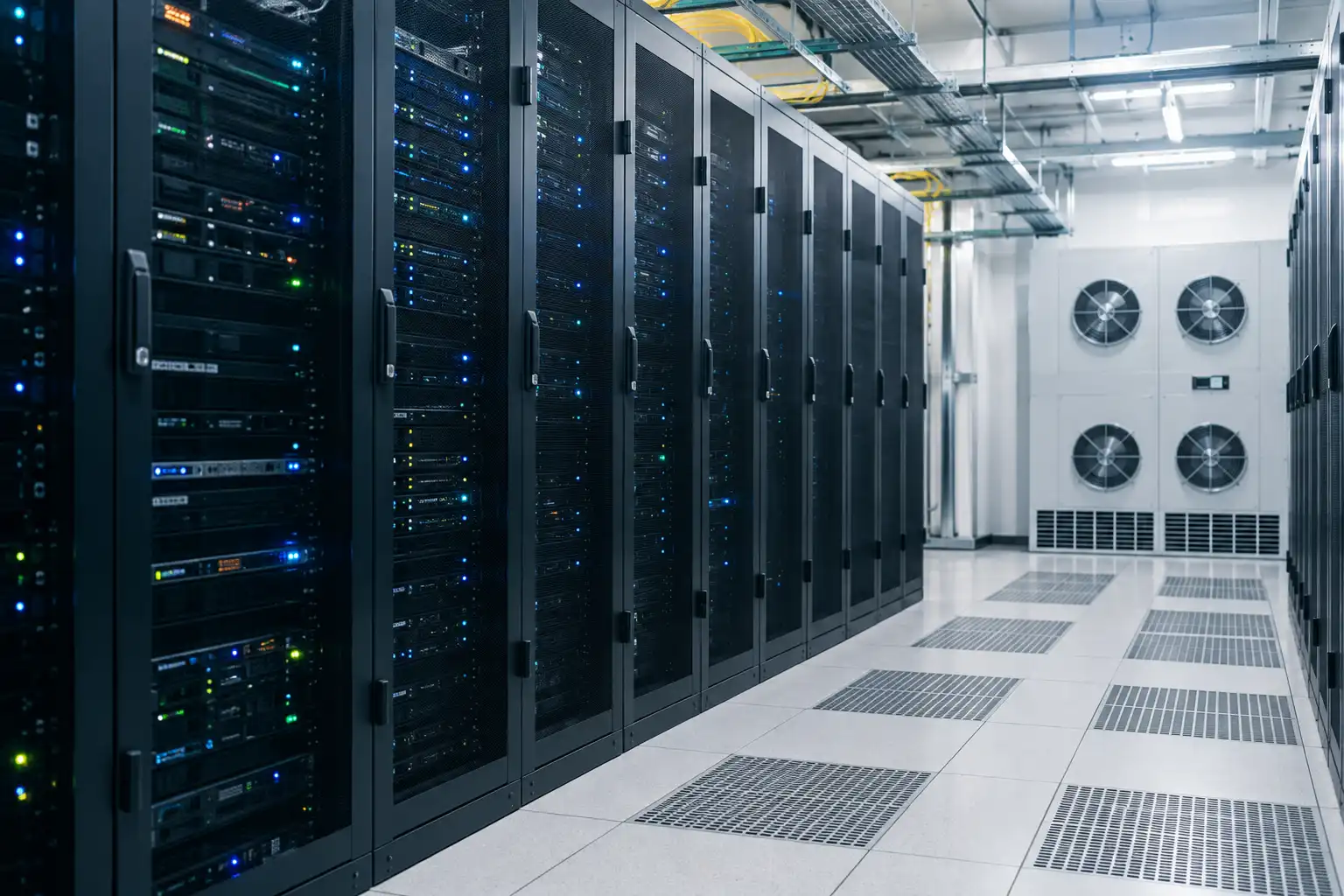
Planning Data Centre Cooling for Future Growth
IT infrastructure continues to evolve rapidly.
Businesses may increase server capacity, introduce more powerful processors, deploy GPU-based systems or expand their use of artificial intelligence and high-performance computing.
These changes can substantially increase heat loads.
Cooling infrastructure should therefore be designed with future requirements in mind.
Scalable solutions can allow additional cooling capacity to be introduced as IT infrastructure expands, potentially reducing the need for extensive system replacement later.
Regularly reviewing cooling requirements is particularly important when new racks or high-density equipment are introduced.
Why Choose Green Cooling for Data Centre and Server Room Cooling?
Green Cooling has over two decades of experience delivering bespoke climate control and cooling solutions.
Our approach combines technical expertise with a strong focus on energy efficiency, sustainability and long-term system performance.
For data centres and server rooms, Green Cooling can provide solutions including:
- Precision air conditioning
- Liquid cooling
- Immersion cooling
- High-density rack cooling
- In-row cooling
- Direct-to-chip cooling
- Free cooling
- Hybrid cooling systems
- Intelligent monitoring
- Energy-saving technologies
- Low-GWP refrigerant solutions
- Installation and commissioning
- Planned maintenance and ongoing support
Rather than treating cooling as an isolated piece of equipment, we consider the wider requirements of the facility, including thermal loads, airflow, resilience, energy performance and future expansion.
Create a More Efficient and Resilient Data Centre
Reliable cooling plays a critical role in protecting IT infrastructure and maintaining operational continuity.
From smaller server rooms to high-density data centres, the right combination of server room air conditioning, airflow management and precision cooling systems can help minimise overheating risks while improving energy performance.
Green Cooling provides bespoke solutions designed around each facility’s individual requirements, helping organisations balance reliability, efficiency, scalability and sustainability.
If you are planning a new data centre, upgrading an existing server room or looking to improve the efficiency of your current cooling infrastructure, contact Green Cooling to discuss a tailored cooling solution.
Frequently Asked Questions
Yes. Green Cooling provides ongoing support alongside cooling system design and installation, including commissioning, planned maintenance, monitoring and upgrade pathways. Regular maintenance helps keep critical cooling equipment reliable and energy efficient while identifying potential problems before they develop into unexpected failures.